What our mobile app development services cover
AlgoKhaleej began as a trading software developer for traders in the GCC. Today we also build apps and websites for businesses in the UAE, Saudi Arabia, Qatar, Kuwait, Bahrain and Oman. Ilyas Kazi runs every project remotely from India, so you always speak with the developer who writes your code.
Our trading tools, such as broker API automation, taught us how to link separate systems safely. Now the same skills power apps for shops, clinics and service teams. In short, our mobile app development services cover the whole job. That means the app, the dashboard behind it, the server, the store listings and every update after launch.
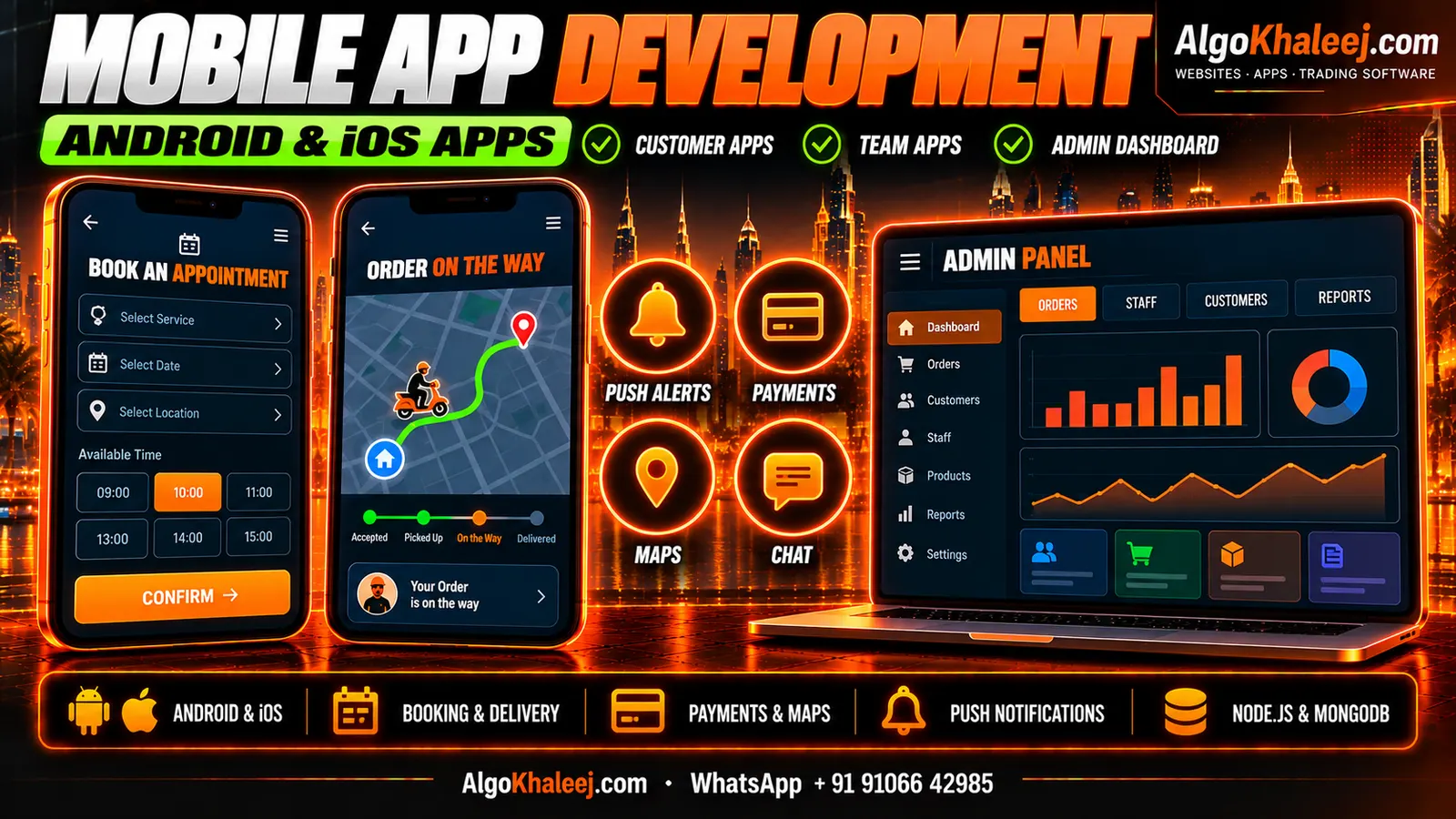
Android and iOS apps for customers and for your team
A customer app lets people browse, book, order and pay from their phone. It also brings them back, because you can send an offer or a reminder in seconds.
A team app works the other way round. Drivers, technicians and sales staff open their jobs, update the status and add photos or notes on site. As a result, the office sees progress without chasing anyone by phone.
We use one codebase for Android and iOS where it fits, and native code where a feature needs it. That keeps the build lean, yet each app still feels at home on its phone.
Booking and delivery apps
Many GCC businesses run on the same loop: a customer books or orders, and a team delivers. We build that loop for:
- restaurants: menus, orders, delivery zones and live order status,
- salons: time slots for each stylist, deposits and reminders before a visit,
- clinics: appointment booking, changes and reminders for patients,
- logistics firms: driver jobs, proof of delivery and tracking for customers.
These apps share a common base. So we spend your budget on the parts that make your business different.
The admin dashboard behind your app
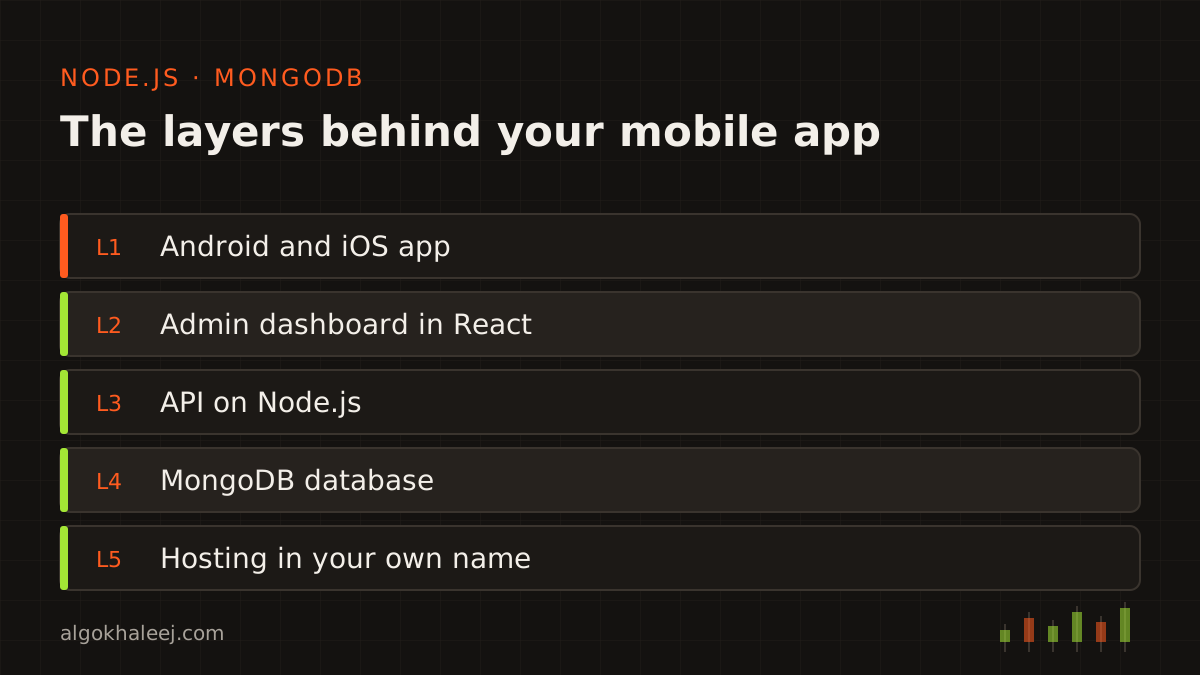
An app with orders or bookings needs a place to run the business. So our mobile app development services include an admin dashboard, a simple CRM that opens in any browser. We write it in React, and it talks to the same server as your app.
Your dashboard covers four areas:
- orders and bookings: new requests, who handles each one, and its status,
- staff: people, roles and what each role may change,
- customers: order history, contact details and notes,
- reports: sales by day, busy hours and top items, with a spreadsheet export.
Owners usually get full access, while staff see only what their role needs. That way, a new cashier cannot delete last month’s orders by mistake.
API integration: payments, WhatsApp, SMS, maps and push
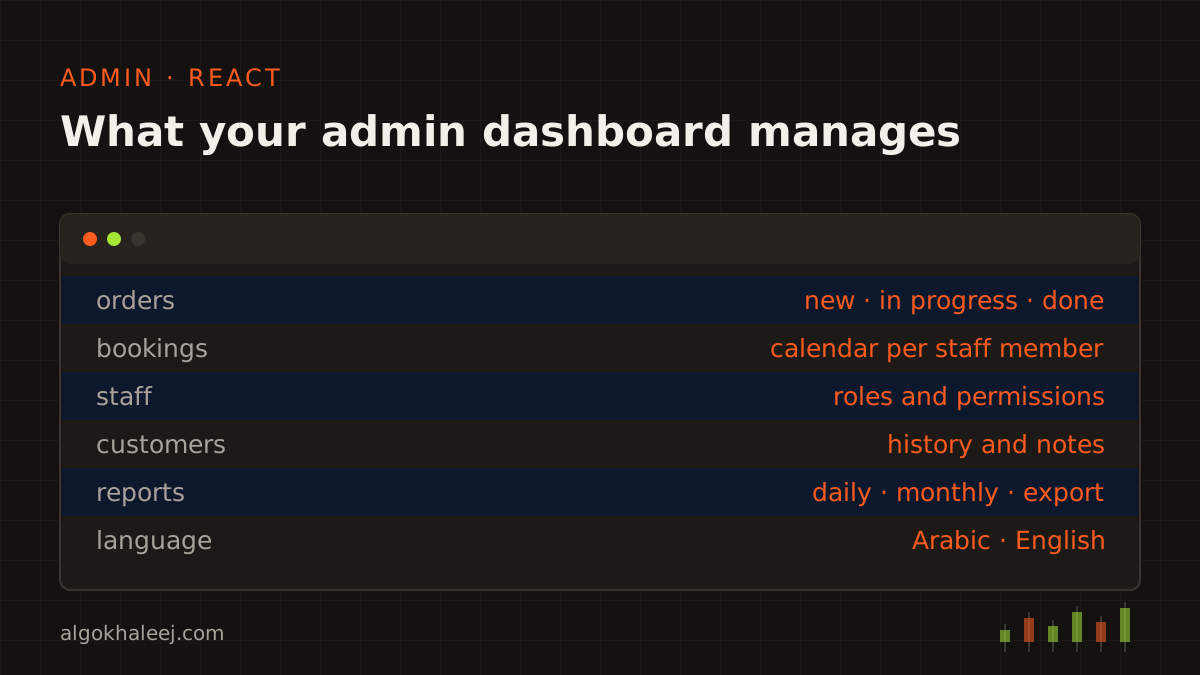
Most apps lean on outside tools. As part of our mobile app development services, we connect yours through each provider’s official API:
- Payment gateways: card payments through a gateway that you choose and sign up with.
- WhatsApp: order and booking updates through the WhatsApp Business Platform.
- SMS: one-time login codes, plus short reminders.
- Maps: address search, delivery zones and live driver location.
- Push notifications: order status, reminders and offers on Android and iPhone.
- Email: receipts and booking confirmations.
One rule matters for payments. For digital content, such as premium features, Apple and Google require their own in-app billing. However, physical goods and services, such as a meal or a salon visit, can use your own gateway. We check this with you during the scope, so the store review holds fewer surprises.
A backend on Node.js and MongoDB
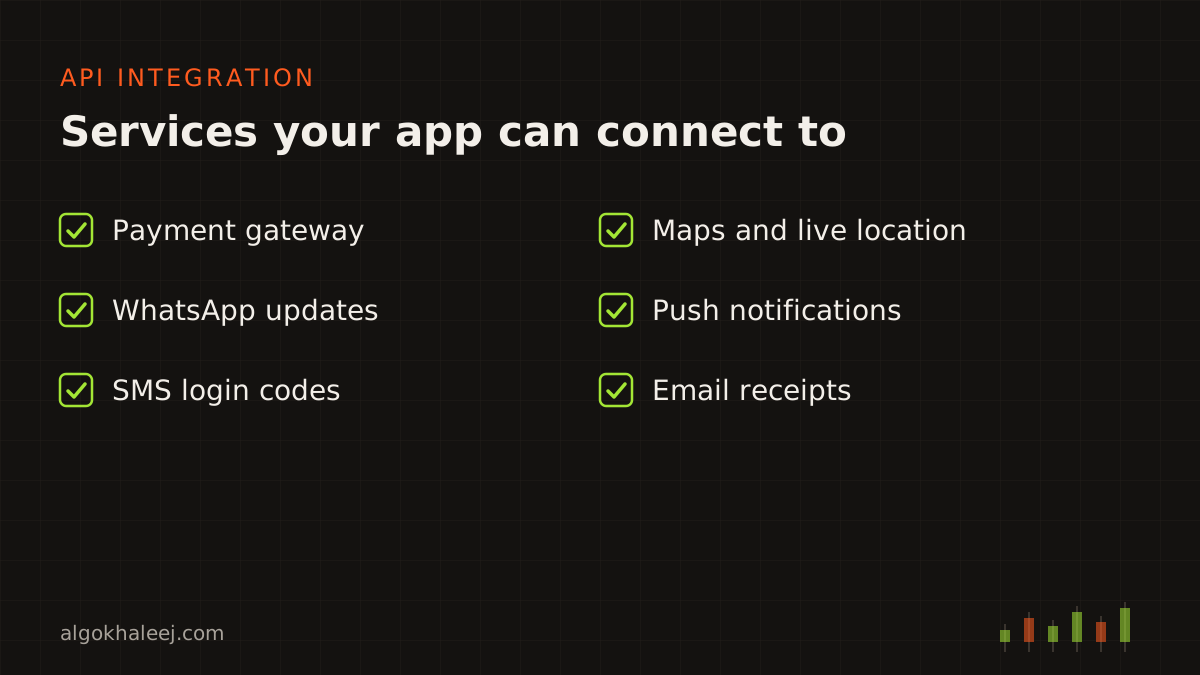
Behind every screen sits a server. It stores accounts, orders and bookings, and it sends each message at the right moment. We write this backend in Node.js and keep the data in MongoDB. Many developers know both tools, so another team could take over the code later if needed.
The server runs on hosting in your own name, such as a cloud account that you control. Our website hosting and maintenance service can set it up and look after it. We also add backups, error logs and secure logins from day one.
Arabic and English screens (RTL)
Customers in the Gulf switch between Arabic and English all day. That is why our mobile app development services treat both languages as equals from the first release. Arabic screens run right to left: menus, lists, forms and arrows all flip. We pick a clear Arabic font and test long Arabic words, so no label breaks the layout. The app can follow the phone’s language, or users can switch inside the app. Your store listings come in both languages too.
Testing on real devices
Simulators help, but they hide real problems. So real-device testing comes with all our mobile app development services. We use real Android phones and iPhones, with small and large screens. We also try slow mobile data, older system versions and both languages.
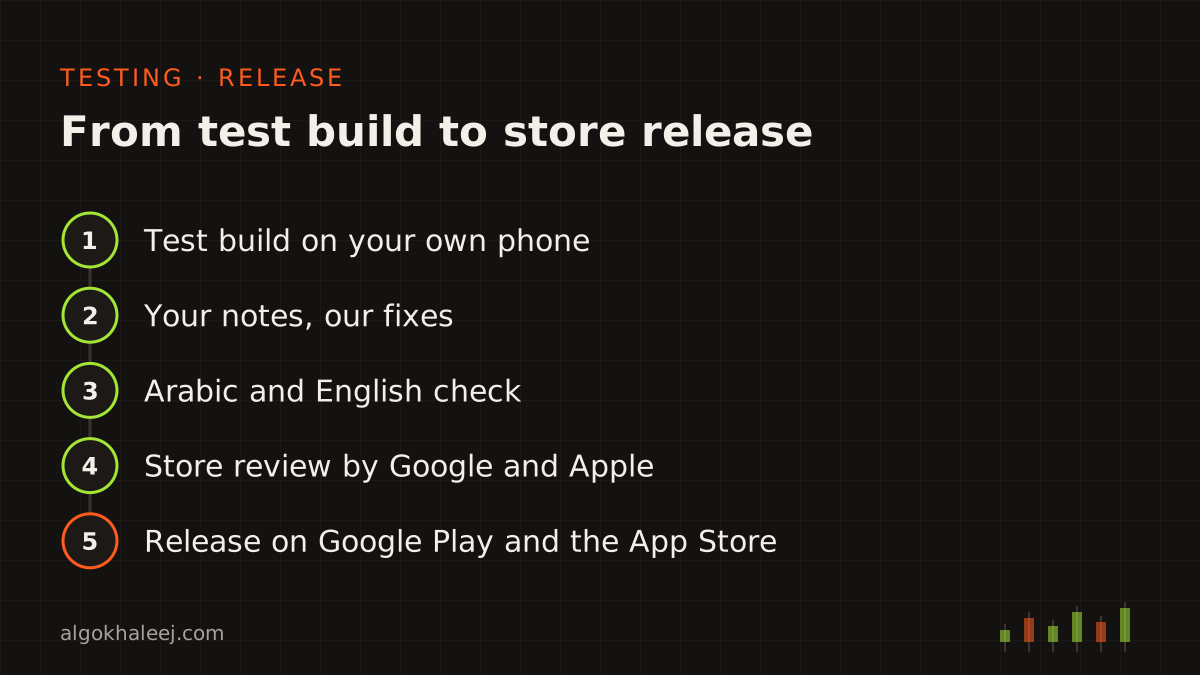
You test too. Before any store release, you install test builds on your own phone. On Android, the build comes through Google Play’s testing tracks. On iPhone, it arrives through TestFlight, Apple’s testing app. Then you use the app as a customer would, and we fix what you find.
Publishing on Google Play and the App Store
Store publishing is part of our mobile app development services, and we always publish under your own developer accounts. First, you open a Google Play developer account and join the Apple Developer Program. You pay their fees directly: Google charges a one-time registration fee, while Apple charges a yearly membership. As a result, the apps, ratings and store data stay in your name, even if you change developers later.
Next, we prepare each store listing with you. It holds the app name, screenshots, Arabic and English descriptions and a privacy policy link. Both stores also ask what data your app collects, and we help you answer that form accurately.
Google and Apple review every new app and update, and they make the final decision. For this reason, no developer can promise approval. Instead, we build to their published rules. For example, Apple sets out its App Store Review Guidelines, and Google explains publishing on Google Play. When a reviewer asks for a change, we fix it and submit again.
Updates after launch
Our mobile app development services do not stop at launch. Every project includes [X] days of fixes for anything that does not match the agreed scope. After that, we handle updates for new Android and iOS versions, store policy changes and new features. Each change gets a quote before we start, so you always know the cost.
We work Sunday to Friday, 12:00–22:00 India time. That is 10:30–20:30 in the UAE and Oman. In Saudi Arabia, Kuwait, Qatar and Bahrain, it is 09:30–19:30. Saturday is our day off.
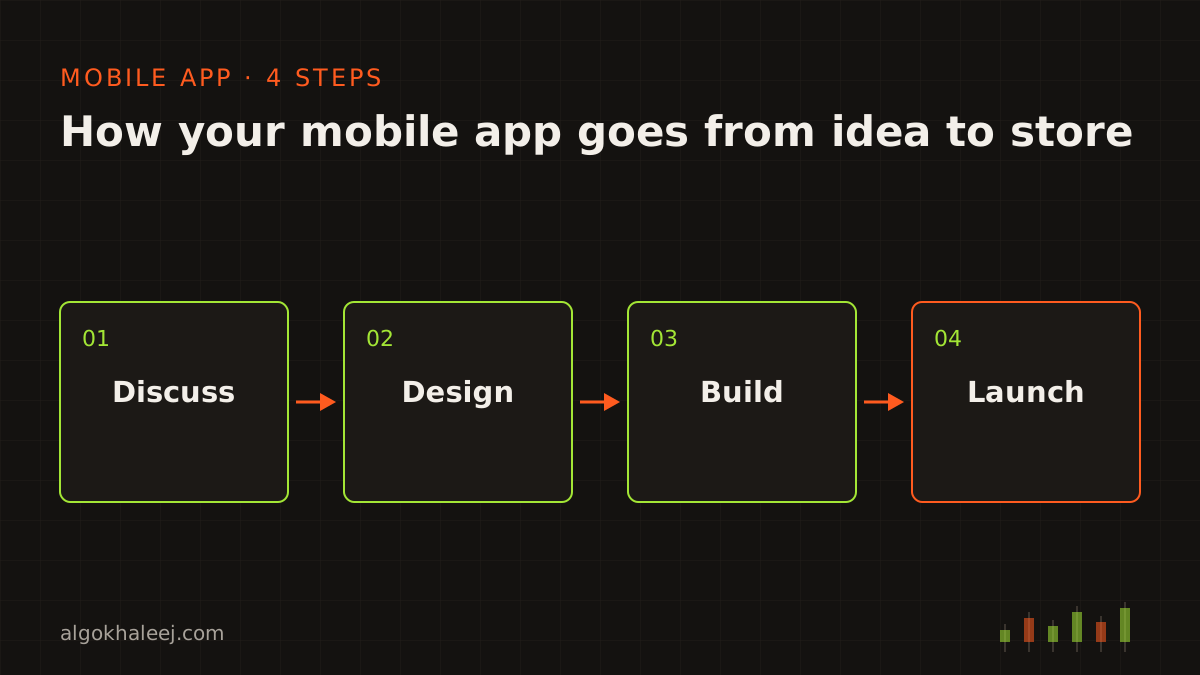
How we build your app: discuss, design, build, launch
Every project in our mobile app development services follows the same four steps.
1. Discuss
First, you tell us what the app must do, who will use it and which services it connects to. Then we write a scope that lists every screen and feature, with one fixed USD quote and a delivery date.
2. Design
Next, we draw the main screens in Arabic and English. You approve the look and the flow before we write code, because changes cost far less at this stage.
3. Build
Now we build the app, the dashboard and the backend. Along the way, you install test builds on your phone and send notes, so nothing waits until the end.
4. Launch
Finally, we submit the app to Google Play and the App Store under your accounts. We answer reviewer questions and stay close while your first customers sign up.
What you receive
When the project ends, our mobile app development services leave you with everything you need to run your app:
- your Android app, submitted to Google Play under your account,
- your iOS app, submitted to the App Store under your account,
- an admin dashboard with logins for your team,
- the backend and database, running on hosting in your name,
- store listings in Arabic and English,
- a short guide that shows your staff how to use the dashboard,
- days of fixes after launch,
- source code, if your quote includes it.
Price of mobile app development services
A simple app starts from $300. Booking, delivery, online payments, admin dashboards and extra integrations cost more, so we quote them per scope. Either way, you get one fixed USD quote before work starts. The price then holds unless you add features.
Store fees and hosting stay separate, because you pay Google, Apple and your host directly. Our pricing page compares all our services and explains how fixed quotes, payments and change requests work. Need a website as well? Our website development services follow the same steps. To start, send your idea through the contact page or on WhatsApp.