Most of our NRI clients in the Gulf ask the same thing first. Can I trade my Indian account properly while I hold a full time job here? You can, once your account type and your daily routine are sorted out.
Futures and options are leveraged and high risk, and you can lose more than you put in. Check with your broker which products your account may trade before you use real money.
NSE hours in UAE and Saudi time
India runs on UTC+5:30. The UAE is on UTC+4, so it sits one and a half hours behind India. Saudi Arabia is on UTC+3, which puts it two and a half hours behind.
That gives a cash session that looks like this:
| Event | India | UAE | Saudi Arabia |
|---|---|---|---|
| Market opens | 09:15 | 07:45 | 06:45 |
| Market closes | 15:30 | 14:00 | 13:00 |
In practice, the open lands at the school run in Dubai and before most offices open in Riyadh. By lunch in Jeddah, the session is nearly over.
The working week matters too. The NSE trades Monday to Friday. For Saudi based traders, Friday is a weekend day at home but a full Indian session, while Sunday is a workday with the Indian market shut. UAE residents have a Saturday and Sunday weekend, so their week lines up with India’s.
Account rules: ask your broker, not a forum
Most problems with NRI trading in Indian stock market accounts start with the account type. An NRI account differs from the resident account you may have opened years ago. Which account you need, which products it covers and which bank account pays for trades all depend on rules your broker applies. Those rules also change over time.
So we will not list them here. Forum posts and old videos often get them wrong, and a wrong guess can freeze an account. Instead, ask your broker in writing and keep the reply.

Seven questions for your broker before NRI trading in Indian stock market
Send these questions as one email or support ticket:
- Which segments can my account trade, and which ones are blocked?
- Can I place intraday orders, or only delivery trades?
- Does my account type allow an API app for automated orders?
- What static IP rules apply to API orders, and how often may I change the IP?
- How long does a login session or API token last?
- Are there order types the API refuses, such as market orders?
- At what time do you square off open intraday positions?
Some answers are already public for certain brokers. For example, Zerodha’s Kite Connect docs say an access token expires at 6 AM the next day. Fyers’ API docs say its tokens expire daily at 6:30 AM India time. ICICI Direct’s Breeze API takes no market orders and no intraday margin orders for shares.
Static IP rules matter most for Gulf traders. Zerodha’s support page says a static IP is needed for API order placement from 1 April 2026. It also says you may change the whitelisted IP only once per calendar week. A home connection in Dubai or Riyadh usually gets a new IP from time to time, and then API orders stop.
A trading morning in Dubai or Riyadh
Daily logins are the part most NRIs forget. A Kite token ends at 04:30 UAE time (03:30 in Saudi Arabia). Fyers tokens last half an hour longer and expire at 05:00 in Dubai, which is 04:00 in Riyadh. After that, any app or script using the old token stops placing orders.
As a result, your morning has a small routine before the 07:45 open in the UAE:
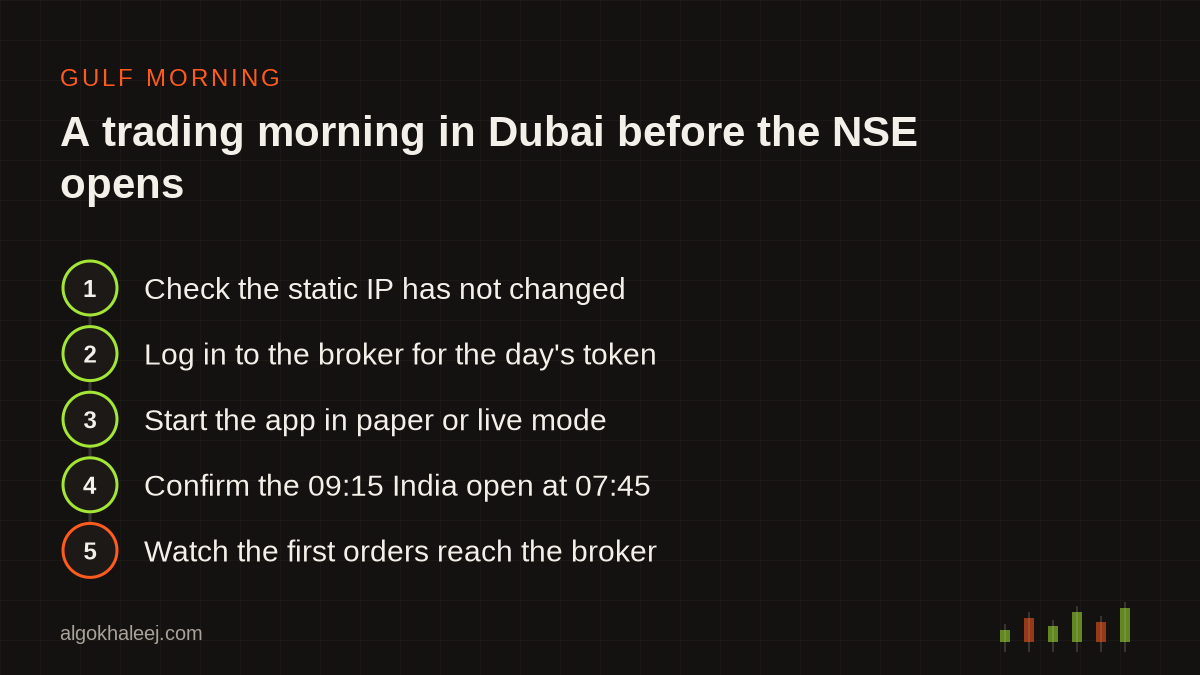
Some brokers make this lighter. Angel One logs in with a TOTP code, and 5paisa can log in automatically once you save your PIN and TOTP secret. Zerodha still needs the daily Kite login in a browser.
Where automation fits for an NRI trader
Automation helps with one problem: you cannot watch a screen from 07:45 to 14:00 while you work. It does not help with account rules, and it does not decide what to trade. Those stay with you and your broker.
Most Gulf based NRIs we speak to start from one of three places.

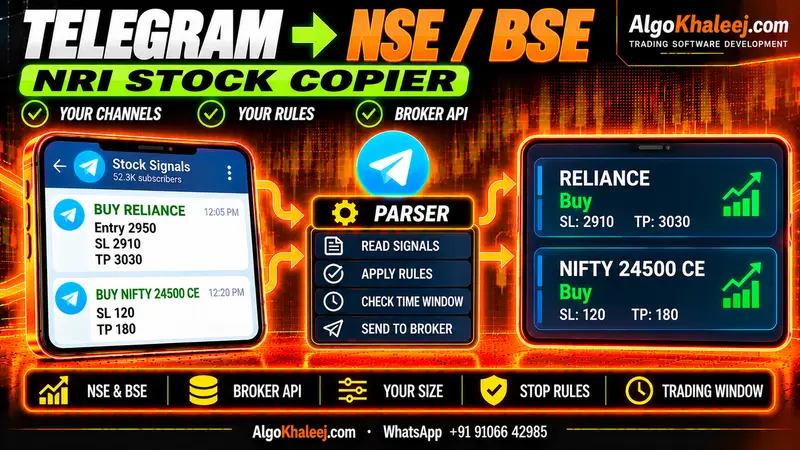
If you follow a Telegram channel, calls arrive while you are in a meeting, and by the time you read them the entry has gone. A Telegram to Indian broker copier reads the call and places the order through your broker’s API. It works with ten brokers, including Zerodha, Angel One, Upstox, Fyers and Dhan.
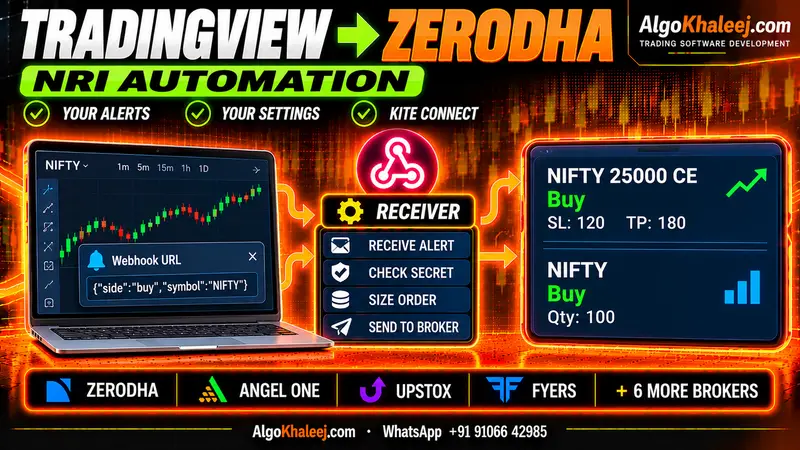
If you chart on TradingView, your alerts already fire on time, but you are not there to act on them. A TradingView to Zerodha automation app turns each alert into an order at the broker. It also shows the IP your broker sees, so a change is easy to spot.
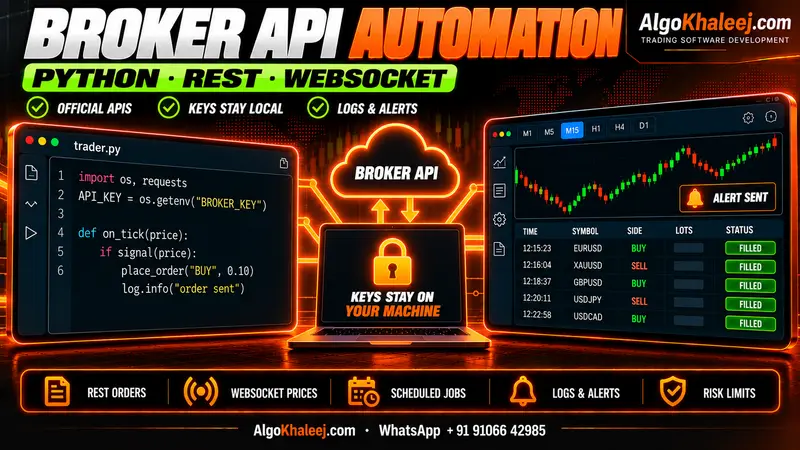
And if you trade your own rules, a ready app may not fit, so broker API trading automation built around your strategy is the better route.
In each case, start in paper mode. Both ready apps have one, and it lets you check a full day of orders before real money moves. Also set a trading window, such as 09:15 to 15:15 India time, which stops new orders before the close.
The limits you should know
Automation does not remove the daily login. Every broker token above still expires, so someone must log in each morning or set up a broker that supports TOTP login.
Equally, it cannot fix a changing IP. If your home line changes its address, API orders stop until you update the whitelist. That is why many traders run the app on a VPS with a fixed IP. Our guide to running trading software on a VPS or a home PC compares the two.
Finally, an app follows your settings and nothing more. A wrong lot size or a missing stop will still be copied. Keep a kill switch within reach, and check your broker’s order book at the end of each day.